When I wrote my first book over a quarter of a century ago it was a full-on physical process. I typed the manuscript on a word processor, took a floppy disc down to the printers in town and paid cash to have the book printed, double spaced, on eighty-gram paper. Three hundred pages, tied up in string, weighed a hefty two kilos. I parcelled it up in a box and sent it by Royal Mail to my editor at Weidenfeld & Nicolson, Ion Trewin. He sent it back three weeks later with glorious hieroglyphics in the margins indicating where he suggested I make changes. That led to another version of the book, draft two, which went through the same process and was sent back to London a month later only to be returned with the copyeditors tweaks and changes. The next time I sent it back it returned in a huge envelope as galley proofs, those magical A3 sheets that lay out the book, two pages at a time, with trim marks in the four corners to show you how big the book will be. As they are so large, galleys are usually folded in half, not with a crease but simply turned over on themselves so they have a glorious undulating shape when you unfold them. Galleys never cease to enchant me. When the book finally arrived through my letter box in October 2000, I held in my hands a solid object which was the sole product of nearly three years of hard work.
Fast forward almost twenty-six years and the whole process of book production and consumption has changed. The research has moved on too, with online access to so much material, some of it highly unreliable, but the writing process for me has not changed. This time, however, I had a co-author, the Everest historian Jochen Hemmleb. He and I fortunately work in a similar manner. I still type my first draft in the same way and I edit now, as I did in the late 1990s, by hand. But once I have made my changes and sent the manuscript off, by pressing ‘send’ on my email, the steps that once bore the idiosyncratic marks of an individual editor now are marked electronically with tracked changes. It is still a creative process, and I love working with editors, proof-readers and, particularly indexers but I do miss the galleys.
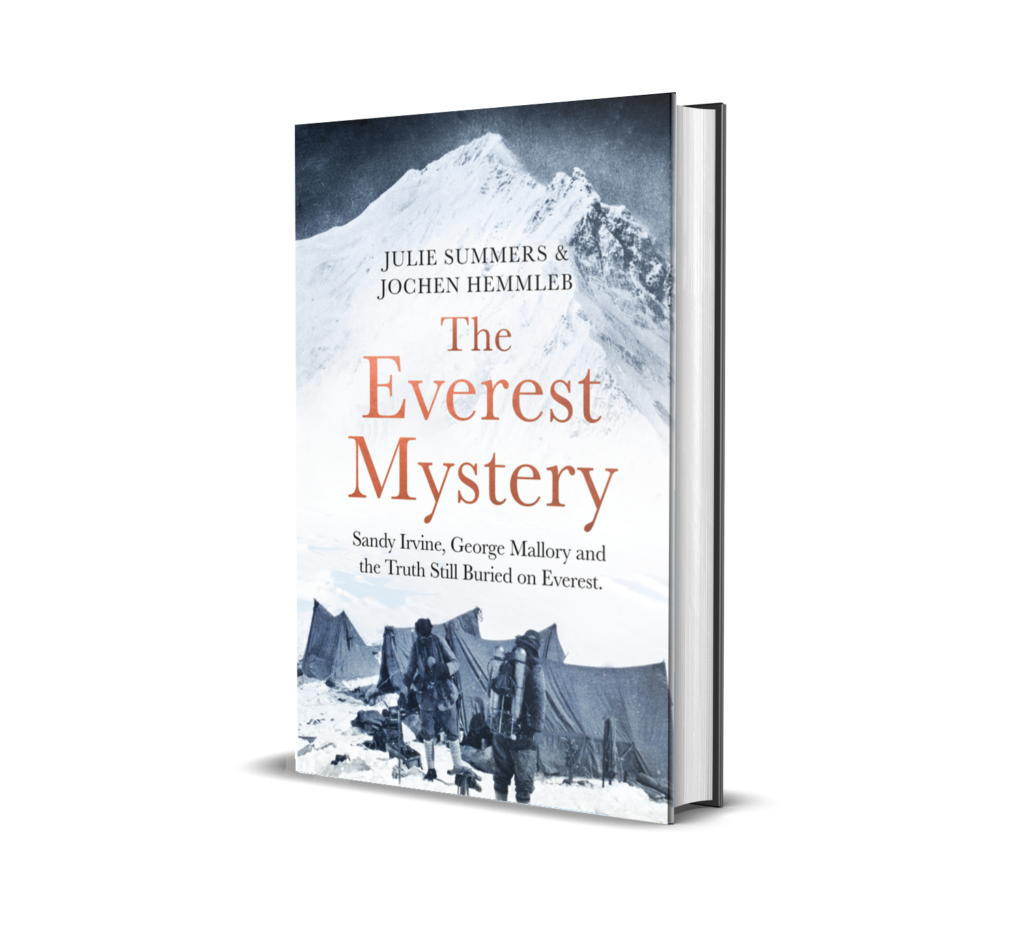
There are new steps in book publishing now which have slipped in organically. The first is the e-book which captures between 20 and 30 per cent of the market depending on whether the book is fiction or non-fiction. The second is the audiobook. This accounts for somewhere between 9 and 12 per cent of sales and is a growing market. Several of my books have been turned into abridged or dramatized audio versions in the past but only two are full-length audiobooks. A recent conversation with a friend, Helen, who had listened to one of my books and found it less than satisfactory, led me to reading The Everest Mystery myself rather than choosing a professional reader. It seemed a bit arrogant to assume I would be able to do it but with a little help from some wonderful friends, I took it on. Over the course of three days in late March, I recorded nine hours and fifty-two minutes of audio with a producer called Dan who took me patiently through the whole process.
Mindful of Helen’s criticism of pronunciation of foreign words and general delivery, I decided to take some advice. First stop was a tutorial with professional voice coach, Elspeth Morrison, who happens to be one of my oldest friends. We were at school together. I recorded an excerpt for her and she critiqued it, which was brilliantly bruising. She also gave me tips on how to warm my voice up, how to look after it so that it didn’t get tired (don’t talk too much), what to drink and eat, and how to sound as natural as possible. That was the most difficult bit, after not talking too much.
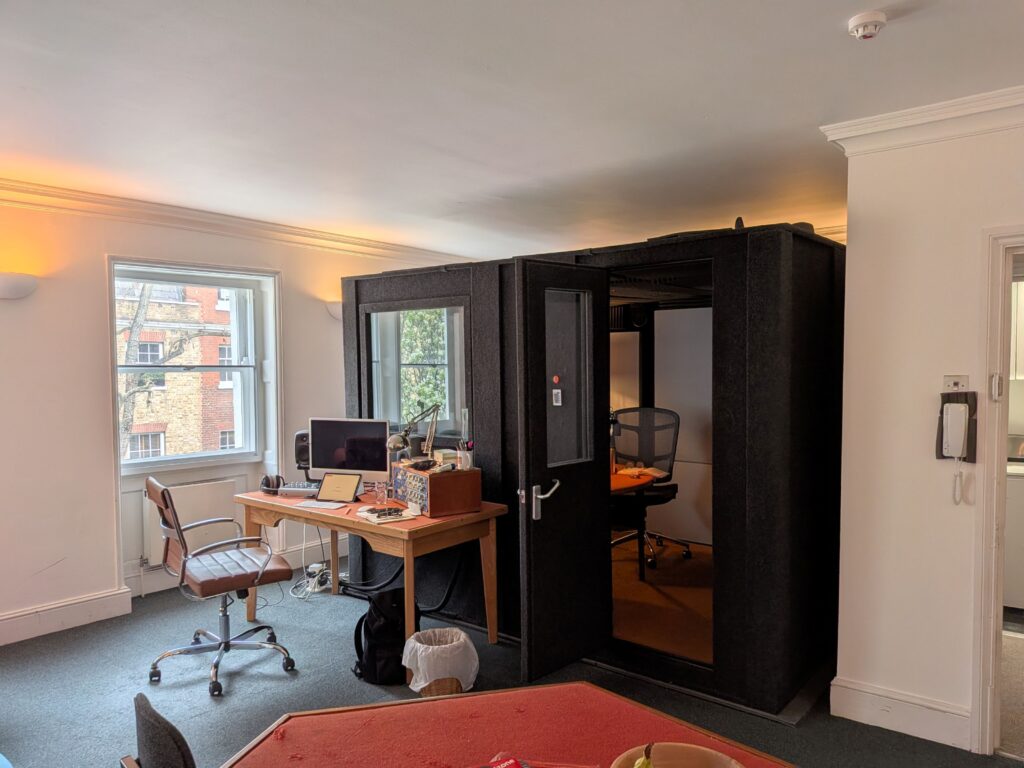
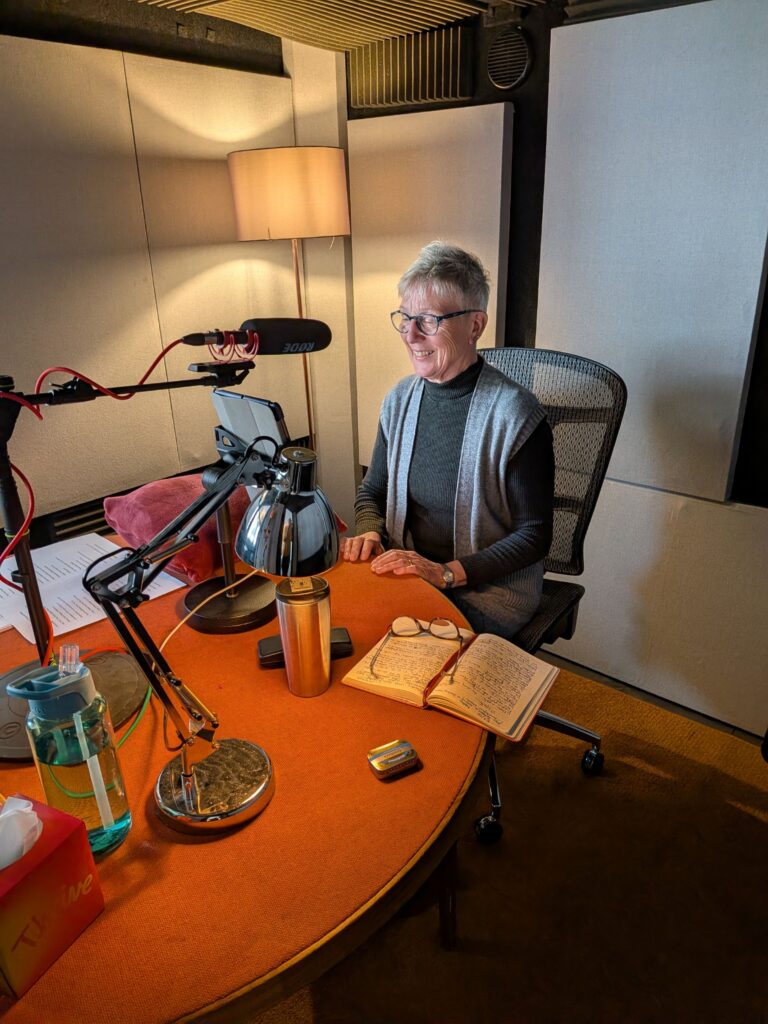
The Studio in SohoMy home for two and a half days in March. Spot the cushion on my right and the long list of difficult to pronounce names
The Everest Mystery, it turns out on closer inspection, has names in over a dozen languages, including Chinese, Tibetan, Russian and two texts in Latin. Should the Latin be read in the style of the 1920s or in today’s Latin my friendly classics professor from Oxford asked me? That is when I realised I had to take this seriously. With thirty-seven Tibetan names I needed help. Oxford is full of brilliant academics who are generous with their time, and I found Ulrike Roesler, Professor of Tibetan and Himalayan Studies in the Faculty of Asian and Middle Eastern Studies who coached me not only on pronunciation but on the meaning of names. It was fascinating and quite moving to learn about the way Tibetan names arise. Then I had to turn to Chinese, which I found a lot trickier. My nephew is married to a Chinese woman, Lily, who was only too pleased to teach ‘Auntie Beetle’, as I am known, to pronounce names like Luoze, Qu Yinhua and Wang Fuzhou. I suspect she will hear very western versions of the names if she listens to the recording, but I did my best. I surprised the producer by being able to pronounce Ffordd Ddwr and Llandyrnog convincingly. A lifetime of listening to my late father enunciate Welsh names helped greatly in that respect and was a lovely reminder of his phenomenal linguistic abilities.
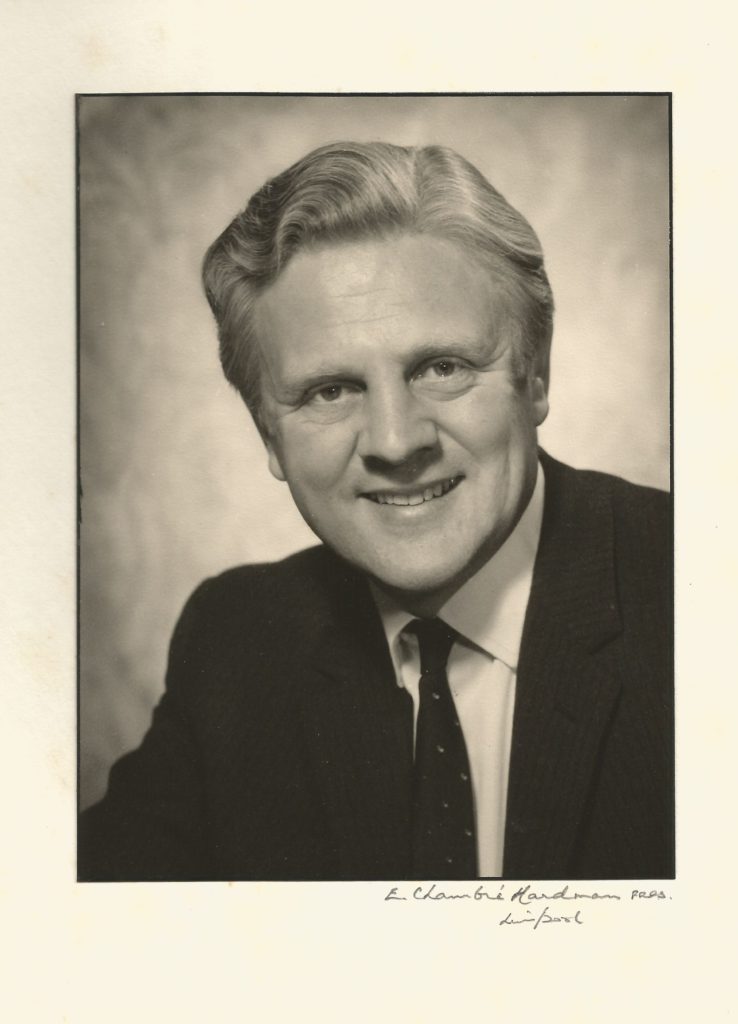
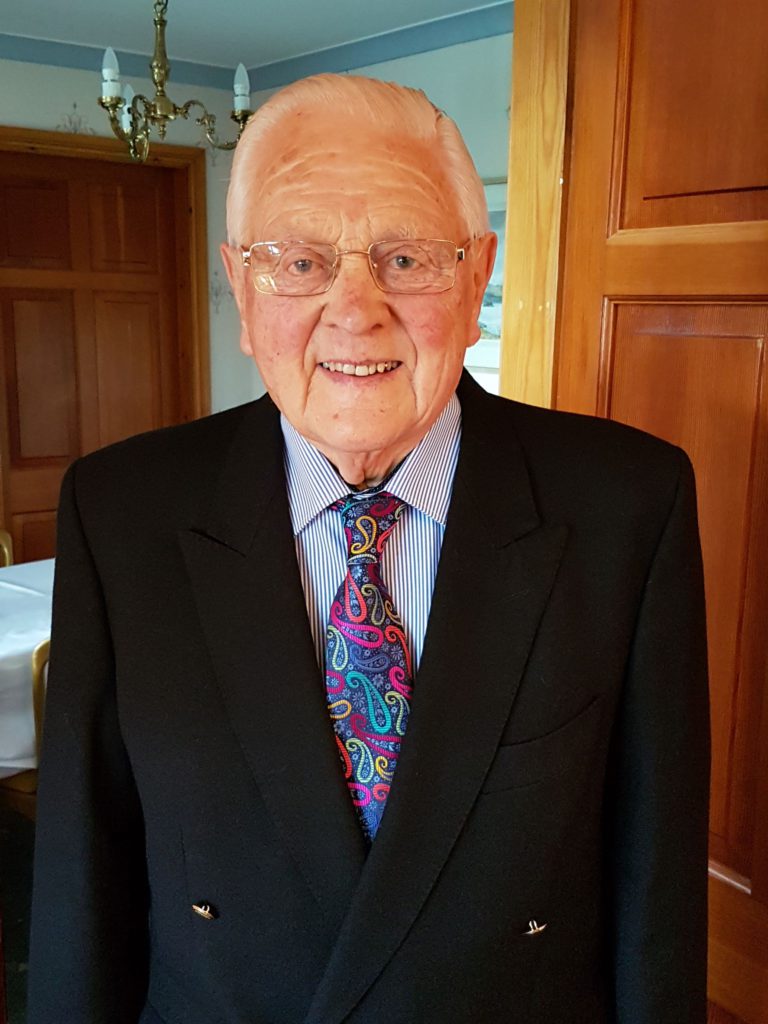
Any excuse to show a photograph of my wonderful father, Peter
Once settled in the studio in Soho, I set out the tools of my trade for the day: a flask of peppermint tea, a bottle of warmish water, cough sweets and a cushion to place over my tummy to stop any unwanted gurgling interfering with the recording. The studio was a soundproof box with a chair, an iPad and a microphone. Stage fright wasn’t an option. I just had to get on with it. It all went swimmingly until I ate a chocolate ginger biscuit in a break and developed a horrible dry cough. Dan handed me a banana, forbade chocolate from then on, and told me to slow down. Over the next three days I read my way through the book from beginning to end, my cheat sheet of tricky words by my side. By lunchtime on the third day, I had finished the epilogue. All that remained were the credits for the UK and US editions. I stepped out into the spring sunshine and made my way to Euston station, only to find it closed. I would have shouted with rage, but I had lost my voice.
This is the eulogy I gave for my father, Peter, at the Service of Thanksgiving we held for him in St Mary’s Church at Acton on 3 March 2022. I do not normally write about my immediate family but several people have asked me for a copy of the words I spoke so I thought I’d break a habit. My father lived a long life spanning ten decades. I remember him saying to me in 1999 ‘good gracious, I never imagined I would make the millennium.’ Well, he did. And another twenty years at that.
I’d like to stand up and talk about Daddy for two hours, but you’ll be glad to know that I will rein myself in and speak for just a few minutes.
Peter John Summers was born at Denna Hall at Burton on 6th May 1929. Over the next ten decades he acquired many more names: Pete, PJ, Daddy, Uncle Peter, FIL (Father-in Law), Grandpa, Great Grandpa. He also had any number of nicknames: Uncle Speeds, the Fat Controller and the Square Squire are just three of them. It is said that a person with many names is someone who is much loved. That is certainly the case with Peter. The messages of condolence we as a family have received over the last fortnight have been beautiful and heart-warming. Words like distinguished and gentleman keep cropping up.
Peter was indeed a gentle man. Throughout his life he eschewed conflict, but he was never afraid to stand his ground when he knew he was right. He did this in his own inimitable way, quite often with a deliberate, silent stare. It could be remarkably effective.
Peter was educated at home by a governess with boys from other local families, including the Behrends, Glazebrooks, Leaches, and Robin Higgin, until it was time to go to the Leas School at Hoylake. From the autumn term of 1939 the school was relocated to Glenridding on the southern tip of Ullswater in the Lake District. There he spent a happy year sharing a room above the post office with his life-long friend, Bill Glazebrook. From Glenridding he went to Shrewsbury School, following in the footsteps of his father and his mother’s five brothers.
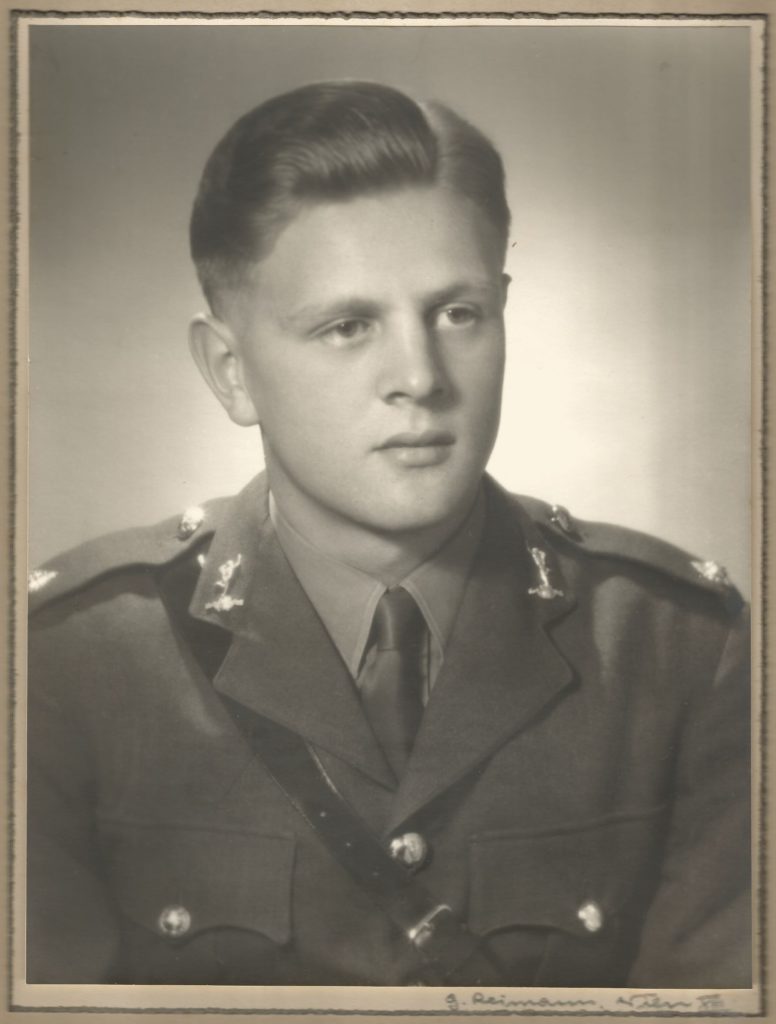
Peter, 1947
After Shrewsbury he moved into National Service, joining the Signals, and spending three cold months in the autumn of 1947 at Catterick. As a young subaltern he was posted to Vienna for a year, living in barracks in the magnificent Gloriette at Schönbrunn Palace. This was the Vienna as depicted in the film the Third Man, made that same year – a city damaged beyond recognition by bombing, divided into four sectors, where the Black Market thrived, and Americans raced around in jeeps. Peter took it all in his stride and was enchanted by the people. He learned to speak German while playing chess with friends he made there. One of them, Geoff Schiffmann, had been a prisoner of war in the Lake District when Peter was at Glenridding as a schoolboy. He remained in touch with Geoff and Etti Schiffmann for the rest of their lives. He encountered Russian soldiers in Vienna and with his brilliant ear for languages, picked that up too. On returning to Britain, he took up his place at Clare College Cambridge, to study Russian and German.
Peter always had a strong pastoral side to his character. Now, with a degree and National Service behind him he told his tutor at Clare he wanted to work with refugees. He was persuaded against this and encouraged to join the family firm. His godfather, Neville Rollason, was sure there would be room for Peter’s youthful ideals and ambitions at The Works. One of the first roles he was given was to draw up a refuse disposal project. This would be the fastest way to learn about the people and purpose of every department in the company.
He joined the board of John Summers and Sons in 1960 with responsibility for staff training and communications. Seven years later the government nationalised the steel industry and Peter joined the new board of the Scottish and Northwest Group of the British Steel Corporation as Director of Personnel and Social Policy. At that time, he had a secretary called Bridget Johnson who we children all delighted in hearing say on the phone in the crispest of tones: ‘This is Bridget Johnson, your father’s secretary. Is your mother in, please?’ In 1973 the government announced it would phase out iron and steel making at Shotton. This ended eighty years of Summers’ family history but not Peter’s. He was given responsibility to assist some of the 6,500 people who would lose their jobs as a result. Thus started the second and most rewarding part of his business career.
As the Industry Coordinator for the Northwest, he moved into a new office, a little bungalow called Park House in Shotwick. From there he and his tiny team encouraged other industries to move to Deeside. My mother, Gillian, used to provide lunches for the Park House brigade and on one occasion had made a delicious coronation chicken. Peter’s PA, Felicity, asked him whether it was from Gillian’s own hens. He replied, ‘yes, this one was called Fred. I remember him well. He had a slight limp’. Peter claimed that Felicity became vegetarian thereafter.
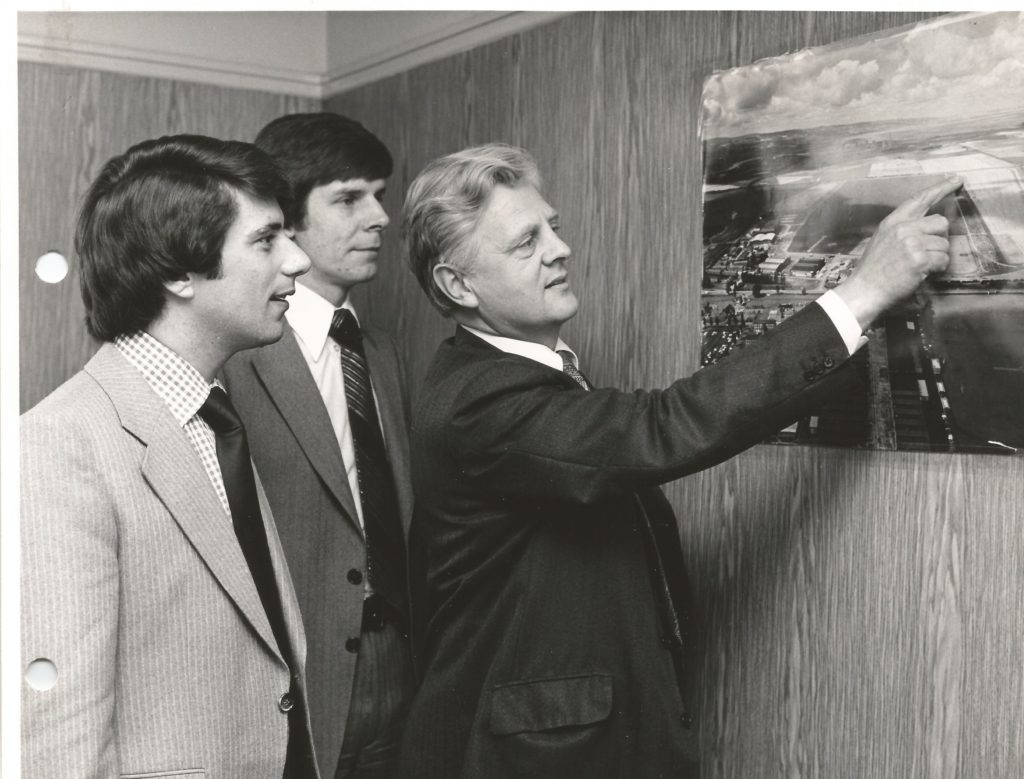
Peter showing the managing director of Iceland Foods where his factory would be sited
He said of his work at Park House: ‘My job with BS Industry evolved continuously and provided me with some of the most rewarding experiences of my working life. Starting a small business from cold in an isolated bungalow spurred on by murmurings of polite disapproval, was an experience I wouldn’t have missed for anything.’ His first signing was Iceland Food and he received a frozen lobster every Christmas from then until he left Park House. For this work and the creation of over 4,400 jobs in 87 new factories, Peter was awarded the MBE. He retired in 1989 at the age of sixty.
What of Peter the family man? In 1957 he met Gillian Toosey, the daughter, as it happened, of a member of his mother’s tennis group in the early years of the century. They made a very handsome couple. With remarkable speed – almost certainly urged on by Gillian – the engagement was announced, and they married on a windy day in April 1958 to much rejoicing. A honeymoon to the South West of the UK and then the continent in Peter’s TR4 followed. He owned every model of the TR series over the course of almost thirty years. We all remember his love of his sports cars.
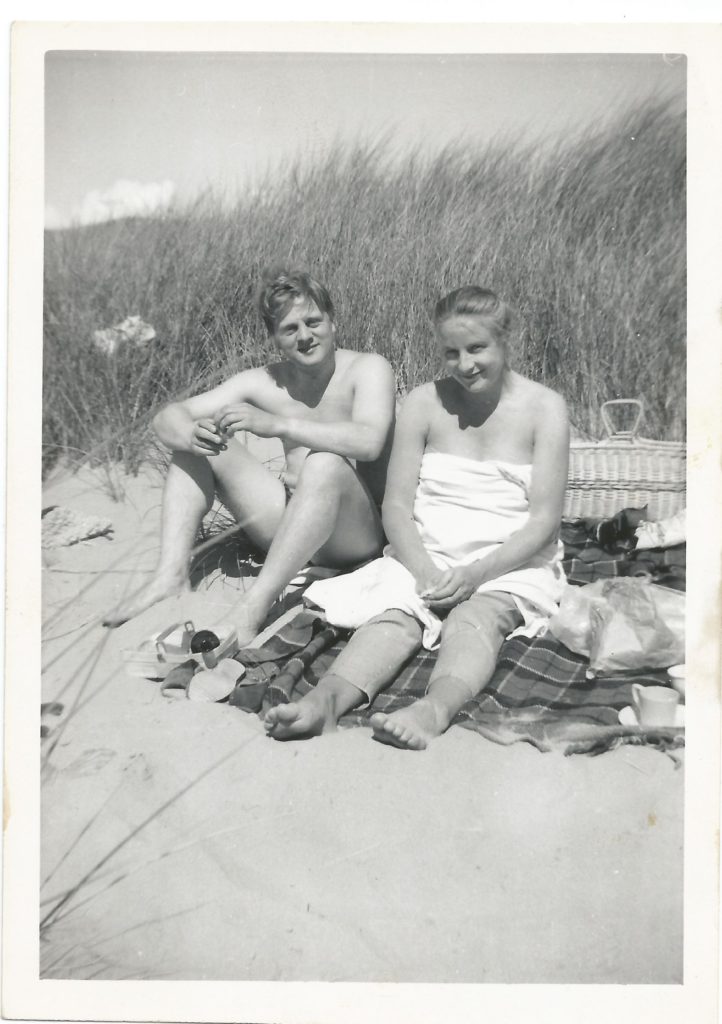
Peter and Gillian in Machynlleth, 1967
Four children followed between 1960 and 1967 – Julie (that’s me), Stephanie, Jeremy and Tim. Life at Delamere Manor, where he moved the family to in 1967, was busy, noisy and unbelievably cold. In 1973 came the oil crisis. The price of oil rose by 300 per cent and Peter turned off the central heating. He did not turn it on again for 45 years.
As children we were fascinated by his various rituals. One was the morning cold bath which he had every day of his life until he retired. Jeremy coined the phrase ‘One, Two, Three Wubbage!’ as Peter hopped into the bath and braced himself for a quick lie down. Another was his breakfast boiled egg which he enjoyed six days a week, latterly seven, until the last week of his life. He timed his egg to perfection on his watch and then solemnly removed it from the pan, ran it under a cold tap, popped it into a yellow egg cup and removed the top with what he called his Ei-Knipps. That, accompanied by toast and Gillian’s delicious marmalade, set him up for whatever the day would bring.
A few years before his retirement he and Gillian bought Fennywood Farm near Winsford. It was their home for more than three decades. They had a small number of cows, endless hens and part-time sheep. At one stage they had a lady who helped Gillian in the house called Anne Card. She had two stock phrases for anything that she found unusual. One was ‘It’s funny, really’ and the other was ‘it’s amazing what they can do nowadays’. One day the AI man came to deal with Peter’s heifers. Mrs Card asked him what the man was there to do and Peter began to explain that rather than having a bull on the farm, the cows would be artificially inseminated. As he was explaining the process as euphemistically as possible, he suddenly got the giggles, wondering which of the expressions she would employ. She rewarded him with a somewhat quizzical ‘it’s funny, really.’
He ran the 40-acre farm in conjunction with the land in North Wales he had bought from his grandfather, Willie Irvine, in the early 1960s. He never tired of telling the story of how Willie had purchased the land as a grouse shoot for his sons, Alec and Tur, and of how his grandfather had grown to love that area of North Wales between Corwen and Bala. Creini, as Peter’s land was known, comprised three farms, a lake and a mountain. He loved that place more than anywhere else on earth. We used to take the caravan to Creini for our summer holidays. Gillian and any number of children, cousins and friends slept in the caravan and awning but Peter always preferred to sleep in a tent some way from our noisy camp. One morning we woke to see his tent entirely surrounded by inquisitive cows.
In 1977 he employed the 17-year-old son of a neighbouring farmer to run Creini for him. Arwel Griffiths worked as Peter’s farm manager for over forty years. Together they learned how best to run the land and maintain the integrity of its unique loveliness. In the early 1980s he decided to learn Welsh and over the course of several summers he attended Coleg Harlech for total immersion in the language. He became proficient and could conduct business successfully in both English and Welsh.
For years sheep would be sent down to Fennywood to overwinter. Peter and Gillian spent many springs lambing up to 150 sheep in the barns there. He would keep lists of every lamb that was born on either farm. Recently he was going through his papers and uncovered a handwritten list of sheep from 1978. All carefully numbered in his meticulous hand, each column ruled with a straight line. He wrote slowly and carefully, making sure every letter in his signature was the right height and shape. As he got older his handwriting slowed down and it once took him 45 minutes to write a cheque.
Peter loved to count. He would note the number of posts and rails along a field edge. He calculated the difference in the number of minutes over the course of a calendar year between daylight and night-time. He had an astonishing eye for detail and, for most of his life, an extraordinary memory. When a few years ago he heard that the Rachmaninoff third piano concerto was about to be performed he hummed the first two bars and said ‘gosh, that’s not often played. I last heard it in 1954.’
Music was another part of his life that he shared with us children in his own way. His grand piano was in the drawing room at Delamere directly below my bed. We all remember him practising at night after supper and we listened while we drifted off to sleep as he played a Chopin nocturne or a Beethoven sonata. His love of opera, Wagner in particular, was elegantly balanced against his passion for the 1970s TV series, Dallas and later, Blind Date with Cilla Black.
As you have heard from Christopher, Peter was a regular church goer for all of his life. He loved the rhythm of the church calendar but was wary of new-fangled ideas and modern hymns. He often read the lesson with clear enunciation and measured speed. A good public speaker, he was a member of the 25 Club, a debating society on the Wirral, for over sixty years. I believe he was its longest serving member.
I cannot end without referring once more to his nicknames, the most affectionate and appropriate of which came not from his immediate family but from his nieces and nephews: Uncle Speeds. Peter did not move fast in comparison to Gillian and that gave rise to the nickname. He also had one habit which anyone who ever had supper at Fennywood will recognise. Towards the end of the evening, he would grab the table edge, half raise himself, and announce: ‘Right, I’m going to bed’. All conversation would stop and those around the table would wait expectantly for him to rise and take his leave. More often than not he would sit back down on his chair and the evening would continue. Then the process would be repeated, sometimes three or four times. One evening Erica Toosey, who was living at Fennywood, got so infuriated with him that she picked up a tea cosy, which was shaped like a hen, and put it onto his head. ‘Uncle Speeds, will you please go to bed!’ She exclaimed. If he did, history does not relate, but the habit continued until well past his 90th birthday.
At the end of his life Peter was afflicted with Alzheimer’s. This cruel disease robbed him of his memory and us of the pleasure of his witty company. He had for as long as we can remember been able to deliver the mot juste for any occasion. When Tim visited him in hospital the day before we eventually sprang him out and brought him home, he said, in answer to the question of ‘how have you been Dad?’
‘I’ve been all over Europe, casting an ever-diminishing shadow.’ He came home on a Friday a few weeks ago and was surrounded by love and care, thanks to the marvellous Lydia Rose team who have been looking after him and Gillian since 2020. He died quietly, peacefully on Tuesday 15th February with Gillian and me at his side. That diminishing shadow has now disappeared but the memories of Peter John Summers, Uncle Speeds, Dad, FIL, Grandpa, Great Grandpa will be around for a very, very long time.